Sunday, 22 August 2021

Jaeger Lecoultre Memovox TÜRLER cal 489


Sunday, May 28, 2017

Jaeger Lecoultre memovox TURLER alarm watch Caliber 489

This is a JLC memovox with dual name Turler. The Türler company was founded as a watchmaking manufactory in Bienne Switzerland on Monday, February 5, 1883. In 1893 the family Türler also founded a specialized shop for watches and jewelry in Zürich. In 1907 the shop located in the Savoy-Hotel at Paradeplatz in the heart of Zürich was opened. 

The Jaeger Lecoultre memovox TURLER alarm watch has been serviced and the alarm works well with a cricket sound. The Memovox was first introduced by Jaeger-LeCoultre in 1950/51 with the manually wound Calibre 489. The two separate crowns allowed you to manually wind and set the alarm and timekeeping parts of the movement separately. The name Memovox is a composite of two Latin word, Memor (remembering) and Vox (voice), meaning "the voice of remembering," a perfect choice for an alarm watch. A few years after, in 1956, the Cal. 489 was replaced with the Calibre 815, making the Memovox the first automatically wound alarm wristwatch.

Jaeger Lecoultre Memovox E855 K825 (stainless steel)


Sunday, June 10, 2018

Jaeger LeCoultre Memovox

This is a gentleman's stainless steel Jaeger LeCoultre Memovox ref 855 in lovely original condition with mechanical alarm in perfect working order - sounding loud and crisp. This is the much rarer large or jumbo 37mm sized version of the Memovox and is an automatic with date function.

The Memovox range is a signature Jaeger-LeCoultre model and one of the icons of 20th century wristwatch design. Over the decades the Memovox has been styled with a variety of different case and dial designs. 

The is an example in a classic Memovox design with a relatively large case, measuring 37mm in diameter. The bold, linear dial has gently tapering indexes which are centrally set with black inserts; the straight baton hands are styled to match with centralised luminescent tips mirroring the luminescent panels set at each hour within the track for minutes/seconds. To the dial centre, the alarm setting disc is finished with a circular satin grain which gives the dial a two-tone appearance – in fact, as the track for minutes/seconds is chamfered inwards it creates the illusion of a 3-tone dial, the eye perceiving three different dial finishes as it catches the light. 

Two Jaeger-LeCoultre crowns are set to the case side, the upper is for winding the alarm barrel and setting the central disc to the alarm time, the lower crown can be used for manually winding the watch if it is completely out of power and also for hand-setting. There is provision for semi-quick date change – the date will change each day around midnight but can be manually advance when required by moving the hands repeatedly between

Jaeger-LeCoultre calibre K825 automatic movement, lever escapement, 17 jewels, compensation balance, 18,000 BPH, Kif-Flector shock absorber, silvered two tone dial,  the chapter ring with sunburst satin finish and applied indexes with black inserts, inner black ring for minutes/seconds with luminous indications at the hours, flat baton hands with blackened tips centred with luminescent panels, central circular satin finished rotating disc for alarm indication with luminescent triangular indicator, framed aperture for date, stainless steel circular case, polished chamfered bezel, satin finished case sides, two Jaeger-LeCoultre crowns, the upper crown for setting and winding alarm, lower crown for time set, two-part satin finished case back with screw-down securing bezel, case, dial, movement and crowns signed. I have traded one of my bubbleback with cash top up for this beauty


Ad from Matthew

Its original bracelet made by Gay Freres


The Jaeger-LeCoultre Memovox calibers
1. The Memovox was first introduced by Jaeger-LeCoultre in 1950/51 with the manually wound Calibre 489. 
2. In 1956, the Caliber. 489 was replaced with the Calibre 815, making the Memovox the first automatically wound alarm wristwatch
3. With Caliber 825 Movement the most iconic Memovox movement, the Calibre 825, which is a cal. 815 with the addition of a date module. so-called "bumper" winding system and the hammer-based alarm

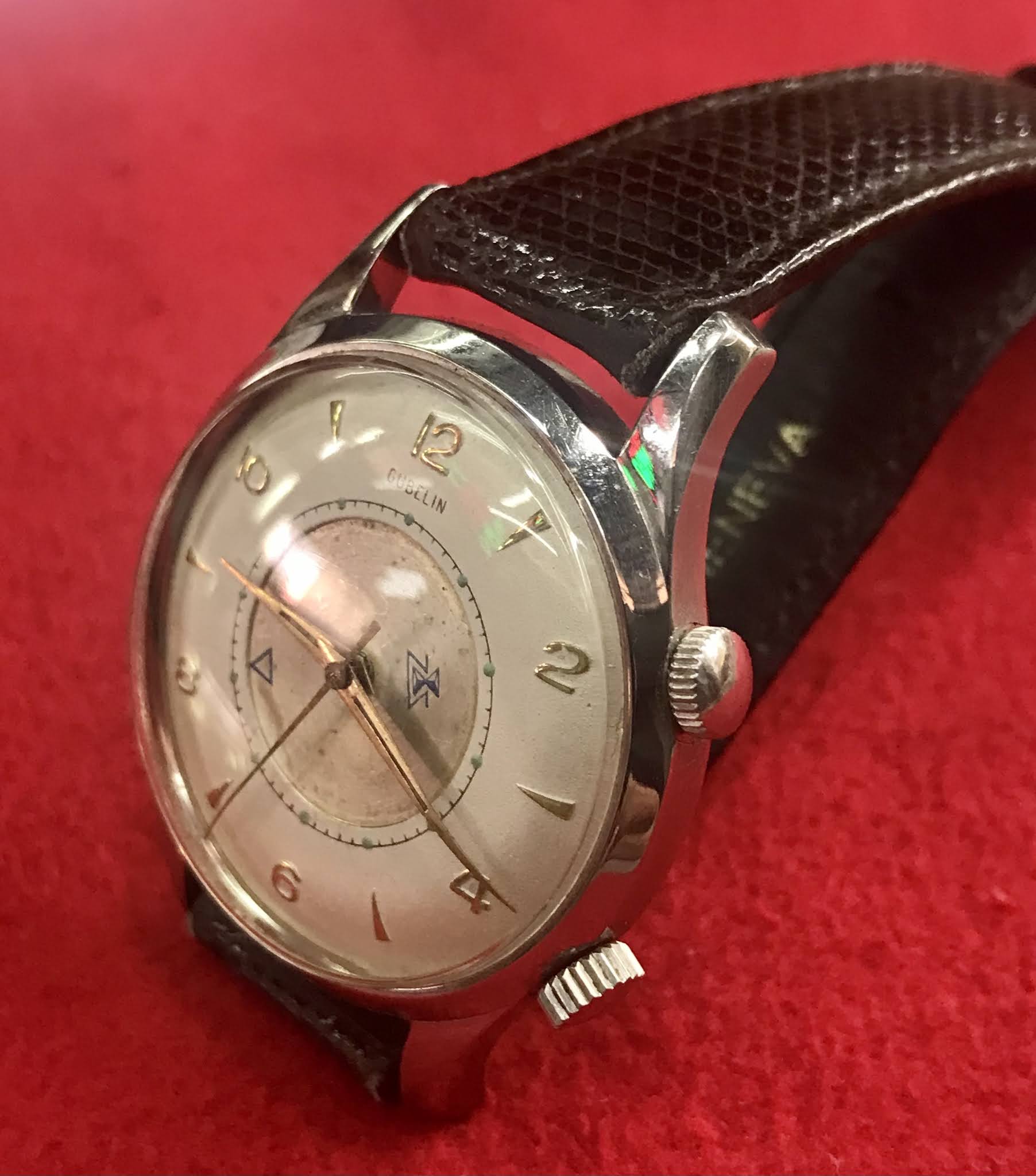
Jaeger Lecoultre memovox GUBELIN alarm cal 489

The Jaeger-LeCoultre Memovox

The Memovox was first introduced by Jaeger-LeCoultre in 1950/51 with the manually wound Calibre 489. The two separate crowns allowed you to manually wind and set the alarm and timekeeping parts of the movement separately. The name Memovox is a composite of two Latin word, Memor (remembering) and Vox (voice), meaning "the voice of remembering," a perfect choice for an alarm watch. This is a special Made for Gubelin company.

https://shop.hodinkee.com/products/2487-gubelin-alarm?variant=39290862567499


Jaeger Lecoultre alarm Cal 489

 Sept 13, 2014

Jaeger Lecoutlre alarm cal 489

Jaeger LeCoultre first launched their alarm watch in 1950. The earliest first version featured calibre 489 as per photo below.


Symbolizing the organization of time and efficiency of the post-war boom period, the Memovox, literally meaning “voice of memory” quickly became the watch for man and It’s striking mechanism gave a pleasant accent to the schedule of daily life: waking up, reminder for appointments, train timetables or parking meters etc.

The first Memovox models were hand wound, Jaeger-LeCoultre Caliber 489. 

The second generation caliber  814 was made from 1953-64. The Calibre 814 was similar to the 489 that it replaced and many of the component parts are common to both units. The key difference between the two calibres is the presence of a distinctive very large plate on the 814, this almost covering the top of the movement when viewed from the back. In 1956, Jaeger-LeCoultre produces extension to the 2nd generations: the first automatic bumper style Memovox, caliber 815 (no date) and caliber 825 (with date).  These watches were very popular and produced in a variety of dials and case materials.  

The caliber 489 has the same total area of plate coverage, but divided almost centrally into two separate plates. The cal 489 was built around three separate bridges, whereas the cal 814 for ease of manufacture, had a single upper plate. The design of the 916 went full circle back to the same three bridge construction that had appeared on the 489 fourteen years earlier.

For the cal 489 model, the upper crown winds and sets the alarm function, entirely independently of the standard timekeeping aspect of the watch, which is controlled by the lower crown. Though expensive to create, this separation had the great benefit of increased accuracy

The most famous use of these two movements was in the highly collectible and expensive divers watches. The 200m rated Deep Sea used the cal 815 and was produced between 1959 and 1961, with only 950 watches produced. The 42mm Polaris used both the alarm complication and JLC's super compressor technology, which was a precursor to today's Master Compressor watches. The Polaris used the cal 825 movement and was tested to 600m. It was produced from 1965 to 1969. 

The 3rd generation was produced in 1962 with the introduction of the  Caliber 910 (no date) and Caliber 911 (with date) is introduced replacing caliber 814.  The new 910, still a manual wind movement, appeared to have incorporated Kif shock protection as standard equipment, removing other shock protection methods and the special shock protection designation as in previous calibers.  By this time, shock protections was standard on all Memovox watches.   The 3rd generation were produced from 1964-79.

1969 - A huge milestone for Jaeger-LeCoultre is the development of the fully automatic bi-directional winding Memovox, resulting in the release of caliber 916.  The 916 was a date version movement, which required a redesign of the alarm mechanism to allow the rotor to swing freely through 360 degrees. The 916 was the first alarm movement in history to incorporate a fully automatic winding system to wind both the timing and alarm mechanism.  It ran at 28,800 beats per hour, compared to the 18,000 beats of all the previous calibers and is often called the "speedbeat", for obvious reasons. This movement developed into caliber 919, then caliber 918 - which was still used up to 2005 in the Master Compressor series. 

There is also the matter of "LeCoultre" vs. "Jaeger-LeCoultre" signatures on both the dials and the movements of watches of this era. For much of the mid-twentieth century, Jaeger-LeCoultre watches sold in the US market were sold under the LeCoultre brand name. 

In summary, the models are:
Cal 489 manual hand wind
Cal 814 manual hand wind
Cal 815 (bumper auto no date)
Cal 816 (bumper auto date) 
Cal 910 (manual hand wind with Kif shock protection)
Cal 911 (with date)
Cal 916 bi-directional winding memovox

Friday, 20 August 2021

Grand Seiko GS56 5646-7010

This is a vintage Grand Seiko GS56 5646-7010 from 1971.

56GS was the last generation of vintage Grand Seiko. Right after Seiko issued the 61GS, there was a need to build the ultimate daily watch that could be used for decades, so there were some majors changes. In order to improve robustness and stability, the frequency of the movement was adjusted to 28800bph from 61GS's 36000bph. The movement was also redesigned to be thin and compact, making 56GS the slimmest automatic Grand Seiko at that time. It also has a cap gold case, which was marketed by Seiko as a premium option and was thus priced a bit higher than the usual stainless steel version. 

The 56GS series of vintage Grand Seiko is second only to the 61GS with regards to the diversity of the watches produced. Whilst utilising only three different movements (there are no “special” or “VFA” examples in this series), there are 35 different models in the series.

With production at Suwa Seikosha starting in 1970 and running through until 1974, the 56GS series marks the end of the line for the vintage Grand Seikos.The three movements that were used in this series were the 5641A (no-date), 5645A (date) and 5646A (day-date), making this the only series with all three complication versions. For the first time, an element of automation was introduced into the production line, and the beat of the movement set at 28,800bph to increase reliability.Whilst there is a large variety of case designs utilised in this range, unlike with the 61GS series, there is consistency in the design and associated numbering of the cases as used across the different movements. 


Monday, 16 August 2021

Rolex ref 1603 Bamboo bezel (from 1960)


Tuesday, April 17, 2018

Rolex 1603 Bamboo bezel Datejust

I have been looking for the 1603 bamboo bezel for a while. Originally, I have seen one at Sheung Wan vintage watch shop but the seller wanted to keep it. I have seen another at TST but the price is very high. After some searching, I have finally found the Rolex Datejust ref 1603 with a very rare Bamboo Bezel at a reasonable price. According  to Osvaldo Patrizzi ’s book, this model has been produced for 1 year only, 1960 exclusively for the Italian Market. The watch dial has aged gracefully with a nice light patina...


One down, 3 to go for 2018....


At certain angles, the patina looks pinkish..

Sunday, 15 August 2021

Vintage Driva Quarter Repeater


Monday, October 09, 2017

Vintage Driva Quarter Repeater

There are many collectors who are speculating and buying various sports models, where the quantities are actually quite huge. Under the radar is a very rare Driva Swiss Quarter Repeater watch. Made in the 1930s. Gold filled and Stainless Steel "Staybrite" gentleman's wristwatch. 15 jewels. Straight line lever escapement, cut bimetallic compensa-tionbalance, blued steel flat balance-spring, repeating on gong by activating slide on the band. Full size of ~23mm wide by 48mm in height. 


Truly once-in-a-lifetime chance to find a repeater with in-house movement. There were only 1500 examples made in the 1930s before production stopped. What made this quarter repeater unique is that its movement is a square movement versus a standard round shape movement.

http://www.watchnet.co.jp/p-eyes/products/detail.php?product_id=3569&PHPSESSID=4485831a899c08e8ad7c8480f7cc962a


Past auctions:


1930-40年代製造 DRIVA レクタンギュラー 大変希少なクォーターリピーター モデルです。右サイドのレバーをスライドさせる事により鐘で時を告げる、この時代の腕時計としては大変希少な品で、厚みのあるステイブライトケースや、ブルースチール針を備えるブレゲナンバーのホワイトダイヤルなど、腕時計としてのサイズ感やデザイン性にも優れた逸品です。

google.com, pub-9153422137839320, DIRECT, f08c47fec0942fa0

Japanese “James Bond” Calendar Auto Orient Swimmer O-19762A

This watch is often referred to as a Japanese “James Bond” timepiece. It appeared in the 1965 TV drama *Spy Catcher J3*, worn by Agent J3—a ...

google.com, pub-9153422137839320, DIRECT, f08c47fec0942fa0